
Rural Ontario — Garden Suites South & North

Garden Suite Oro-Medonte,
Springwater & Muskoka

Three predominantly rural jurisdictions. Almost no municipal water and sewer. Conservation authority overlays on much of the land. And a meaningful funding opportunity in Muskoka that most homeowners don’t know about. The septic question comes before everything else here — and we know these lots well.

Three Areas — Quick Reference
Springwater Township (Simcoe County)
ARU statusFormally permitted — up to 2 units
ServicingMixed — serviced villages / rural septic
Conservation auth.NVCA (Minesing Wetlands area)
Oro-Medonte Township (Simcoe County)
Zoning bylaw97-95 — comprehensive review underway
ServicingAlmost entirely rural well & septic
Conservation auth.NVCA and LSRCA — check both
District Municipality of Muskoka
JurisdictionDistrict — 6 area municipalities
FundingMAHIP loan $40K–$50K per unit
ServicingAlmost entirely rural well & septic

All three areas are predominantly rural. The septic assessment must precede any design work. Confirm current bylaw status directly with your municipality before committing to plans or permits.

The short answer

Usually yes, but these are rural areas with almost no town water or sewer, so septic capacity comes before everything, and conservation authority rules cover much of the land. Muskoka also has its own forgivable money for new units: $40,000 for 10 years of affordable rent or $50,000 for 15 years, with the 2027 window open until January 8, 2027.

Lot Layout

Garden Suite Oro-Medonte:
A Typical Rural Lot Layout
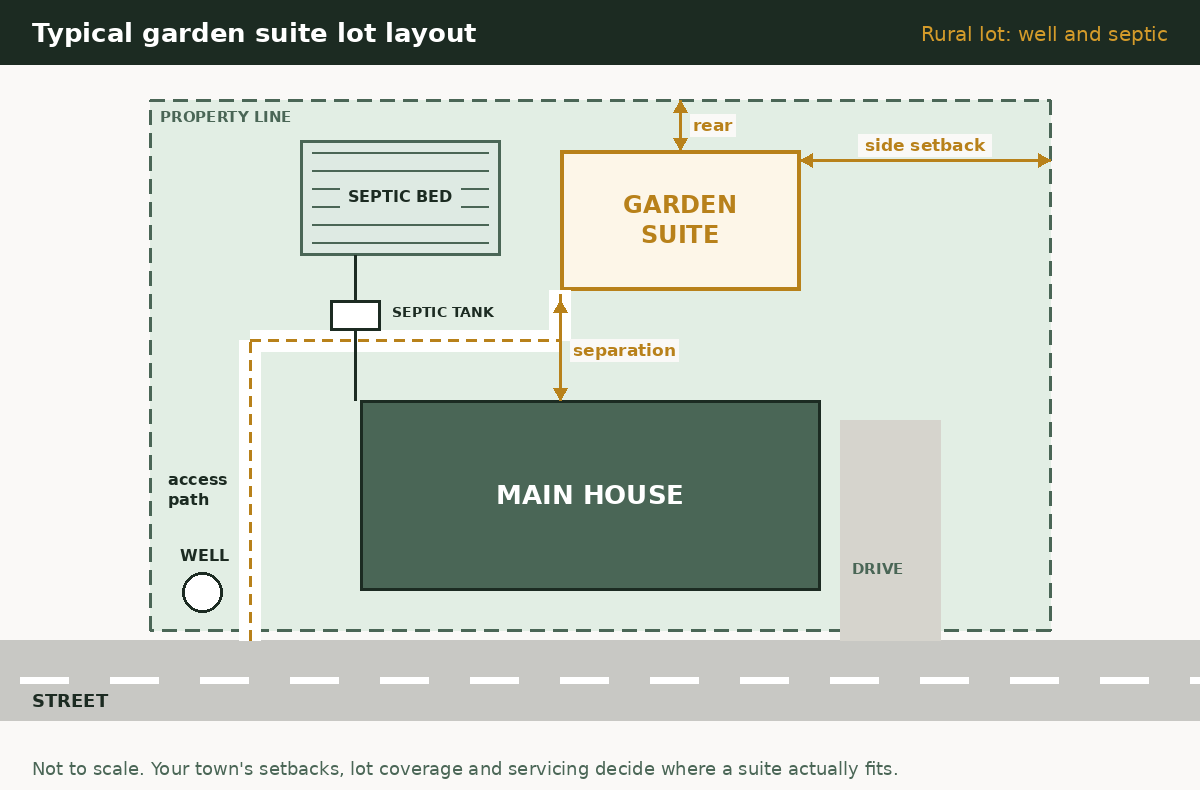
Garden suite Oro-Medonte rural lot layout: house, garden suite, septic bed, septic tank and well with setbacks

On a rural lot the septic bed and the well get first pick of the yard, and the garden suite gets what is left. The bed has to stay clear of the well, the buildings and the property line, so the suite usually ends up beside the bed, not on the nicest spot in the yard. Treat this as a sketch, not a site plan. Your septic design and your town set the real distances.

Why these three areas are in one guide: Oro-Medonte, Springwater, and Muskoka share the same defining characteristic for garden suite planning — they are almost entirely rural, almost entirely on private well and septic, and conservation authority overlays affect large portions of all three. That means the septic feasibility question and the conservation authority permit question dominate every rural project here. The bylaw frameworks differ, but the on-the-ground realities are strikingly similar. Read the complete Ontario garden suite septic guide first →

Municipality-by-Municipality Rules

What’s Different About Each
Jurisdiction — and What’s the Same

The Planning Act framework applies to all three, but the local bylaw details, funding programs, and on-the-ground realities differ. Here is what you need to know for each.

Township of Springwater
Simcoe County · Zoning By-law 5000 · ARU By-law Formally Amended · Settlement areas: Elmvale, Midhurst, Minesing, Hillsdale
Simcoe County

ARU Framework

ARU statusFormally permitted — by-law amended
Maximum ARUs per propertyUp to 2 accessory units
Registration requiredYes — automatic after final inspection
Zoning By-law5000 (amended for ARUs)
2025 bylaw updateZB-2025-003 — confirm current status
Serviced areasElmvale, parts of Midhurst
Rural areasWell & septic — assessment required
Simcoe County grantUp to $50K forgivable loan
Contact705-728-4784

What Springwater Homeowners Need to Know

Springwater formally amended its Zoning By-law to permit Additional Residential Units — up to two per qualifying property. ARUs are automatically registered with the Township after building permit final inspection and a secondary address is assigned.
Springwater is undergoing an ARU bylaw update (ZB-2025-003 was in draft as of 2025). Confirm current ARU standards directly with Springwater Building at 705-728-4784 — some details may have changed since the base amendment.
Restrictive covenants from older subdivisions may override the zoning bylaw ARU permissions. Springwater explicitly notes that restrictive covenants may be implemented by a developer of a given subdivision. Check your title and survey before assuming full as-of-right permission.
Elmvale and parts of Midhurst have municipal water and sewer — the path to a garden suite is more straightforward here. Rural Springwater properties (Hillsdale, Minesing, Orr Lake, Snow Valley area) are on private well and septic — the septic assessment comes first.
The Minesing Wetlands area in northern Springwater is a Provincially Significant Wetland. Properties near this area or near the Nottawasaga River are in NVCA regulated territory. Check nvca.on.ca before committing to any project.
Springwater collects development charges on behalf of the Township, Simcoe County, and school boards. The Simcoe County Secondary Suites forgivable loan (up to $50K for most Springwater properties) is available for projects where the unit will be rented at attainable rates for 15 years.
Township of Oro-Medonte
Simcoe County · Zoning By-law 97-95 (under comprehensive review) · Predominantly rural — well & septic throughout
Simcoe County

Planning Framework

Zoning By-law97-95 (comprehensive review ongoing)
Official PlanAdopted October 5, 2022
ARU eligibilityConfirm with Planning — review ongoing
ServicingAlmost entirely private well & septic
Conservation auth.NVCA and LSRCA — both apply
Septic programTownship-administered within 100m buffer
Building permitsCloudpermit — online system
Contact705-487-2171

What Oro-Medonte Homeowners Need to Know

Oro-Medonte’s Zoning By-law 97-95 is undergoing a comprehensive review to align with the 2022 Official Plan. The current ARU/garden suite provisions should be confirmed directly with Oro-Medonte Planning — the new comprehensive bylaw may change specific standards and eligibility criteria.
Oro-Medonte is unique in being regulated by both the NVCA (for the western and northern portions of the township in the Nottawasaga watershed) and the LSRCA (for the eastern and southern portions near Lake Simcoe). Check both authority maps before assuming neither applies to your property.
The Township administers a septic maintenance program for properties within 100m of lakes, streams, and waterways (using LSRCA and MOE mapping). If your property is in this buffer zone, your septic system is subject to inspection requirements — and a second dwelling unit will amplify regulatory scrutiny of the system.
Horseshoe Valley has some communal wastewater infrastructure, but most Oro-Medonte properties — including Bass Lake, Shanty Bay, Edgar, Craighurst, Moonstone, and rural areas — are on private septic systems of varying age and condition.
The Simcoe County Secondary Suites forgivable loan (up to $50K) applies to qualifying Oro-Medonte projects where the unit will be rented at attainable rates.
District Municipality of Muskoka
Separate District — 6 area municipalities · Bracebridge · Gravenhurst · Huntsville · Georgian Bay · Lake of Bays · Muskoka Lakes
District — Not Simcoe County

Muskoka ARU Framework

Upper tierDistrict of Muskoka (not Simcoe County)
Lower tier bylawsEach area municipality has own ZBL
MAHIP ARU loan$40,000–$50,000 per unit (interest-free)
Loan typeForgivable — long-term affordable rental
Max units fundedUp to 2 units per property
DC By-law2024-34 (effective Jan 1, 2025)
ServicingAlmost entirely private well & septic
ARU guidemuskoka.on.ca/housing
MAHIP contact705-645-2412 ext. 4410

What Muskoka Homeowners Need to Know

The District of Muskoka has its own ARU forgivable loan — $40,000 or $50,000 per unit through the MAHIP Capital Incentives Program. This applies to garden suites and is explicitly called out as an eligible ARU type. Up to two units per property can be funded. Units must be rented at or below District-approved average market rents.
Muskoka is a two-tier government. Garden suite rules are set by the six area municipalities — Bracebridge, Gravenhurst, Huntsville, Georgian Bay Township, Lake of Bays Township, and Muskoka Lakes Township — each with their own zoning bylaws. Confirm your property’s specific eligibility with your area municipality’s planning department, not the District level.
Muskoka is almost entirely on private well and septic — there are very few municipal sewer systems. Every garden suite project in Muskoka starts with a septic assessment. Muskoka’s lakes, rivers, and wetlands make conservation authority requirements particularly important. Many properties are subject to local conservation authority review.
The recreational and tourism character of Muskoka creates a distinct tension between short-term rental use and the ARU program’s requirement for long-term affordable rental. The MAHIP forgivable loan requires units be rented at or below District-approved rents — incompatible with STR use. If STR is the intended use, the loan does not apply.
Construction must begin within 120 days (4 months) of receiving MAHIP funding approval. Work completed prior to written approval may not be eligible for reimbursement.
Muskoka’s Unique Funding Advantage

The MAHIP ARU Loan —
$40,000 to $50,000 Per Unit

Most Ontario homeowners outside Simcoe County have no access to a local forgivable loan for garden suites. Muskoka homeowners do — through the District’s MAHIP Capital Incentives Program. Here is exactly what it offers.

Program Details

Maximum per unit$40,000–$50,000
Interest rateInterest-free
Loan typeForgivable (conditions apply)
Maximum units per propertyUp to 2 units
Program nameMAHIP Capital Incentives
Eligible ARU typesGarden suite, secondary suite, in-law
Rent requirementAt or below District avg market rent
Occupant income limitVerified at move-in
Construction startWithin 120 days of approval
Contact705-645-2412 ext. 4410

How It Works — and What to Watch For

The MAHIP ARU loan is provided through the District of Muskoka’s Affordable and Municipal Housing Improvement Program. It is a forgivable loan — meaning it does not need to be repaid if you comply with the terms for the full term of the agreement.

Forgiveness is conditional on renting at or below the District’s approved alternate average market rent and maintaining income-eligible tenants (income verified at move-in). This is a long-term affordable rental commitment — not for STR use or market-rate rentals.

The loan is registered as a mortgage on title by the District. If you sell the property or stop renting at the approved rate before the term ends, the unforgiven balance becomes repayable.

Work cannot begin before written approval. Any construction started prior to written confirmation of approval may not be eligible for reimbursement. Apply before breaking ground.

The application requires all applicable regulatory approvals to be in place — building permit, septic permit, and any conservation authority permit — before funds are released. Budget for the full regulatory process before expecting to access funding.

This program can be combined with the CMHC insured mortgage refinancing (90% of post-renovation value, 30-year amortization), which allows you to fund the construction portion through your mortgage and use the MAHIP loan to reduce the amount you need to borrow. Full financing guide →

Oro-Medonte’s Unique Challenge

Two Conservation Authorities —
One Township

Oro-Medonte is unusual in Ontario: it sits at the boundary between two separate conservation authority watersheds, meaning properties may fall under NVCA jurisdiction, LSRCA jurisdiction, or in some cases both — depending on where on the lot the work is planned.

NVCA — Nottawasaga Valley (Western & Northern Oro-Medonte)

The NVCA regulates the western and northern portions of Oro-Medonte — the parts of the township that drain into the Nottawasaga River system. This includes areas around Horseshoe Valley, Moonstone, Edgar, Warminster, and portions of the township extending toward Barrie.

For garden suite projects in NVCA-regulated portions of Oro-Medonte, an NVCA permit is required before the building permit can be issued. The NVCA reviews for hazardous lands, wetlands, floodplains, and sensitive natural features. The permit adds 6–12 weeks and $500–$2,500 in application fees to the project timeline.

Check your property at nvca.on.ca using the online regulation mapping tool. If it shows a regulated area designation, contact the NVCA before proceeding with any design or permit work.

LSRCA — Lake Simcoe Region (Eastern & Southern Oro-Medonte)

The LSRCA regulates the eastern and southern portions of Oro-Medonte — the parts that drain toward Lake Simcoe. This includes Bass Lake, Hawkestone, Shanty Bay, Shanty Bay Beach, and shoreline and near-shoreline properties in the southern part of the township.

The Lake Simcoe Protection Plan imposes stringent requirements on development within the Lake Simcoe watershed — including setback requirements from the lake and tributary watercourses, phosphorus loading restrictions, and stormwater management requirements. In some cases, Advanced Treatment Units are required for septic systems near the lake regardless of soil conditions, due to the lake’s nutrient sensitivity.

Oro-Medonte administers a mandatory septic maintenance program for all properties within 100m of lakes, streams, and waterways identified in LSRCA and MOE mapping. Adding a second dwelling unit on a lot within this buffer will attract additional scrutiny of your septic system’s condition and capacity.

Check lsrca.on.ca for the regulatory mapping. If your property is near Lake Simcoe, Hawkestone Creek, or any identified waterway in southern Oro-Medonte, LSRCA involvement is very likely.

The practical implication: In Oro-Medonte, we check both authority maps on every project — not just one. It is more common than you might expect for a property to have portions in each watershed, or to be close enough to the boundary that review by both is warranted. We do this as part of every preliminary lot assessment in Oro-Medonte. Our $399 + HST feasibility report checks both for your specific lot.

What Makes These Areas Different from Urban Simcoe County

Five Rural Realities That Affect
Every Project in These Areas

These are the factors that distinguish a garden suite project in Oro-Medonte, Springwater, or Muskoka from a project in urban Barrie or Collingwood — and why the planning sequence is different.

1
Septic Before Everything Else

These areas are almost entirely rural. Before a design, before a zoning call, before a budget conversation — the septic situation must be assessed. The system may have adequate capacity, need a tank upgrade, need full replacement, or require an ATU. Which scenario you are in determines a project cost variable of $0 to $55,000+. Full septic guide →

2
Large Lots Can Hide Constraints

Rural lots are often described as “2 acres” or “5 acres” — which sounds like unlimited space. But the leaching bed occupies a significant area. Conservation-regulated land may be unbuildable. Slopes, rock outcrops, mature tree canopies, drainage corridors, and setbacks from wells and waterways consume lot area quickly. The actual building envelope is often much smaller than the total lot size suggests. We assess this before any design conversation.

3
Construction Access Is a Real Cost

On rural lots, equipment access through gates, over fields, across unstable soils, or navigating mature forest to reach the rear of a large property adds meaningful cost. Excavation equipment, concrete trucks, and material deliveries all need viable access routes. This is assessed on-site, not from a satellite image. Lot feasibility guide →

4
Utility Extensions Are Longer

On a rural lot, the distance from the main house to the garden suite site may be 50, 100, or more metres. Electrical service, communications, and water line extensions (if connecting to a shared well) all get more expensive with distance. Electrical is the primary utility cost and is typically run from the main house panel or requires a subpanel at the suite. Budget for conduit and wire runs appropriate to your specific site, not a suburban estimate.

5
ICF Is Particularly Worth Considering Here

On rural properties, the garden suite is typically the only building on a large parcel — no urban heat island, exposed to wind and weather, often in areas with older hydro infrastructure and periodic power interruptions. ICF construction’s superior thermal mass, airtightness, and resilience make it particularly appropriate for year-round occupancy in rural Ontario. The premium pays off in utility cost and comfort over a 20-year horizon. ICF garden suite guide →

Side-by-Side Comparison

Springwater vs. Oro-Medonte vs. Muskoka
At a Glance

The key differences across the three areas — to help you understand where your project sits before your first call with us.

Factor Springwater Oro-Medonte Muskoka
Jurisdiction tier Simcoe County lower-tier Simcoe County lower-tier District Municipality (own tier)
ARU bylaw status Formally amendedZB-2025-003 update in progress Comprehensive review underwayZBL 97-95 — confirm current rules 6 area municipality bylawsEach municipality separately
Dominant servicing type Mixed — serviced villages + rural septic Almost entirely private well & septic Almost entirely private well & septic
Conservation authority NVCA (northern portions) NVCA and LSRCA — check both Local CAs — check area municipality
Local forgivable loan Simcoe County — up to $50K Simcoe County — up to $50K MAHIP — $40K–$50K per unit
Restrictive covenant risk Some subdivisions — check title Less common — mostly older lots Check title for cottage area restrictions
STR tension Moderate High — active STR enforcement Very high — recreational market
Building permit system Municipal — springwater.ca Cloudpermit — oro-medonte.ca Each area municipality separately

Building a Garden Suite in Oro-Medonte, Springwater, or Muskoka?

We build across rural Simcoe County and work with Muskoka properties. We know the conservation authority processes, the septic realities, and the bylaw frameworks in all three areas. Our $399 + HST feasibility report tells you whether your property works — in 48 hours, and credited toward your build — before you spend anything on plans or permits.

FAQ

Questions from Oro-Medonte, Springwater & Muskoka Homeowners

The questions we hear most frequently from homeowners in these three rural areas.

Get a written answer for your property →
Yes, in principle — they address different parts of the financing stack. The CMHC insured refinancing allows you to borrow up to 90% of your property’s post-renovation value to fund construction. The MAHIP forgivable loan provides up to $40,000–$50,000 as a grant-like incentive that reduces the net cost of the project (and therefore the amount you need to borrow). The two can be structured to work together: you use the CMHC refinancing to access construction funds, and the MAHIP loan offsets a portion of that debt if you rent at qualifying rates. The MAHIP application requires disclosure of other funding sources. Work through the combination with a licensed mortgage broker who understands both products. Full financing guide →
It depends on your area municipality’s zoning and the designation of your property. Cottages in Muskoka are often zoned for waterfront or recreational residential use — not standard residential. Garden suites (additional dwelling units) are generally permitted on properties zoned for residential use in conjunction with a principal dwelling. A waterfront or seasonal-use zoning designation may require a zoning amendment to permit an additional dwelling unit. Your specific area municipality’s planning department can confirm what your zone permits. Additionally, the MAHIP loan requires the new unit to be rented at affordable rates as long-term housing — which is incompatible with a seasonal-only or STR use. Confirm all of this with your area municipality and the District before proceeding.
Not automatically. A large lot means more space for a leaching bed if you need to replace or expand the system — which is a meaningful advantage over smaller rural lots where space constraints force more expensive solutions. But it doesn’t mean your existing system has capacity. The question is what the system was designed for, how old it is, whether the soil still drains adequately, and what the combined load of house plus garden suite will be. We have seen 5-acre lots where the existing system had plenty of capacity and the garden suite was straightforward, and 5-acre lots where the leaching bed had failed silently over 30 years and needed complete replacement. Size helps with the solution — it doesn’t determine whether there’s a problem. A septic assessment tells you which situation you’re in. Full septic guide →
Springwater had a draft ARU bylaw update (ZB-2025-003) in progress as of early 2025. This update was amending specific standards under Zoning By-law 5000. Whether it affects your project depends on which specific provisions are being amended and whether your property type and location fall under them. The only way to know is to confirm the current adopted standards directly with Springwater Building at 705-728-4784 — they can tell you what the current in-force rules are for your specific zone and property type. Do not rely on this guide or any other secondary source for specific bylaw details; the bylaw text is the authoritative reference and it changes.
Yes. Springwater’s ARU information explicitly notes that restrictive covenants from subdivision developers may override zoning bylaw permissions. A restrictive covenant is a private agreement registered on title that binds current and future owners to certain restrictions — which may include prohibitions on accessory structures, additional dwelling units, or rentals. Zoning bylaw permissions do not override restrictive covenants. Before assuming your property qualifies for a garden suite based on zoning, have a real estate lawyer review your title for any restrictive covenants. If one exists that prohibits additional dwelling units, you would need to seek a court order to modify or discharge it — a potentially expensive and uncertain process. This is a standard part of any pre-application due diligence on a property with a subdivision history.
Construction costs in Muskoka generally track the Simcoe County range — $340–$490 per square foot — though some Muskoka projects run higher due to more challenging site access, longer material transport distances, and greater site complexity on recreational properties. The septic component in Muskoka often trends toward the more expensive scenarios (Scenarios 3 and 4 in our septic guide) because of the soil conditions, proximity to water, and age of many existing systems. A one-bedroom garden suite all-in on a Muskoka rural lot typically totals $260,000–$380,000 depending on site conditions — with difficult lakefront or conservation-area sites pushing to $400,000 or beyond. The MAHIP loan ($40K–$50K) meaningfully offsets this if you plan long-term rental use.
Muskoka adopted a new Development Charges By-law (2024-34) effective January 1, 2025. Under Ontario’s Bill 23 framework, the second and third residential units on a residential lot are generally exempt from municipal development charges — though the District of Muskoka and school board education development charges may still apply. The exact DC exposure for a Muskoka garden suite depends on your area municipality’s DC bylaw and the District’s current schedule. Confirm the full DC picture — District, area municipality, and education — directly with your area municipality before finalising your project budget. Development charges apply at permit issuance and can be a significant upfront cost if not anticipated. Development charges guide →
Garden Suite
Feasibility Report
[YOUR ADDRESS] · 48 HRS
The Verdict
GO — with conditions

Know Before You Spend a Dollar —
The $399 + HST Feasibility Report

A written, property-specific answer researched by a licensed Ontario builder — not a sales call. Delivered within 48 hours. Here is exactly what you get:

  • Zoning & setback check for your specific lot — with the bylaw sections cited
  • Servicing & septic capacity assessment (the #1 rural deal-breaker)
  • Site, equipment access & conservation-overlay review
  • Realistic all-in budget and the funding your project qualifies for
  • A clear GO / NO-GO verdict, in writing
  • Your next three steps, in order
Get My Report — $399 + HST →Fully credited toward your build · Secure Stripe checkout